
I Benchmarked Qwen’s Fast MoE Model Locally. It Was Confidently Wrong Half the Time.

Qwen’s MoE model Qwen 3.6 35B A3B generates tokens 3.5x faster than its dense 27B sibling on my local hardware. Qwen’s published benchmarks suggest you only give up 5–10% accuracy for that speedup. That’s an incredible trade-off.
I ran a local SWE-bench experiment to find out if I could replicate the numbers. The headline result: when the MoE model did submit an answer, it was wrong or completely invalid over 52% of the time.
Here’s how I got there.
Why Speed Matters for Local LLMs
With hosted models, your limiting resource is money — price per token caps how much you can do. With local models, tokens are essentially free (ignoring cost of electricity). So the constraint shifts: time becomes precious. Tokens per second dictate how fast a model can solve problems, and on commodity hardware that can feel like a crawl compared to hosted alternatives.
This is what makes Mixture of Experts (MoE) architectures appealing. In an MoE model, only a subset of parameters are active for any given token, making generation significantly faster than their dense model counterparts. Qwen 3.6 35B A3B has 35 billion total parameters but only activates ~3 billion at a time — hence “A3B”.
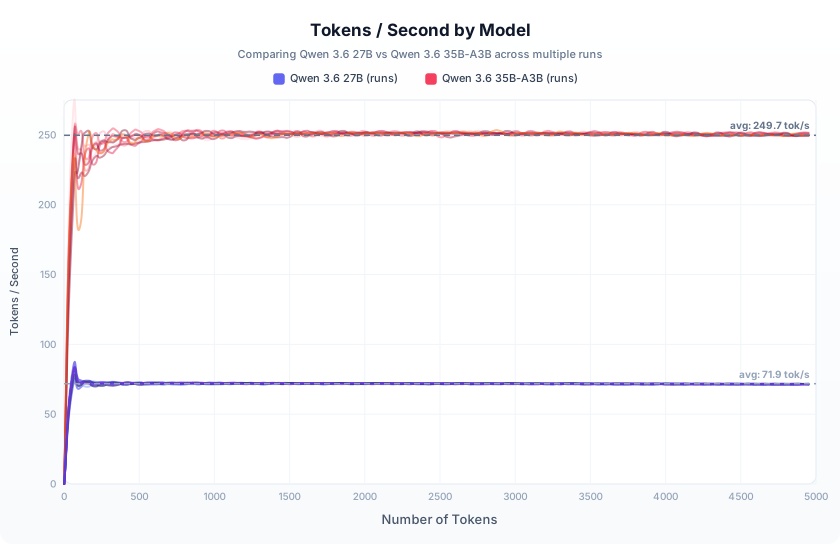
The chart above shows the results of running a prompt with reasoning disabled purely for the purpose of capturing token generation speed. Accuracy (or even coherence) was not a factor. Running both models locally on an RTX 5090 using llama.cpp server:
llama-server -m ./models/qwen3.6-27b-q4_k_m.gguf \
  -ngl 99 \
  -c 80000 \
  --port 8080 \
  --host 0.0.0.0 \
  -fa on \
  --log-file logs/$(date +%s).log
and then running a prompt that would be sure to generate a lot of tokens by sending a chat completions style request to the machine on my network that was hosting the llama.cpp server:
curl http://192.168.1.173:8080/v1/chat/completions \
  -H "Content-Type: application/json" \
  -d '{
    "messages": [
      {
        "role": "user",
        "content": "Write an extremely detailed, exhaustive tome about the history of computer science starting with the invention of fire. It should take a human lifetime to read."
      }
    ],
    "stream": true,
    "max_tokens": 5000,
    "ignore_eos": true,
    "chat_template_kwargs": {
      "enable_thinking": false
    }
  }'
We can see that the 35 billion parameter MoE variant is about 3.5x faster at generating output than the dense 27 billion parameter model. We get about 250 tokens per second with 35B A3B vs about 72 tokens per second with 27B.
So if our limiting factor is time when running local LLMs, then we should always use this MoE variant!
Not so fast.
Time vs Accuracy
As with all things, there is a trade-off. The MoE variant isn’t quite as ‘smart’ as the denser model. Comparing the published benchmarks we see that the performance looks comparable but the lead is clearly with the 27B variant.
Interestingly, on their HuggingFace Model Card, their SWE-Bench Verified results show only about a 5-10% difference in task completion. Similar results are shown across other common benchmarks as well.
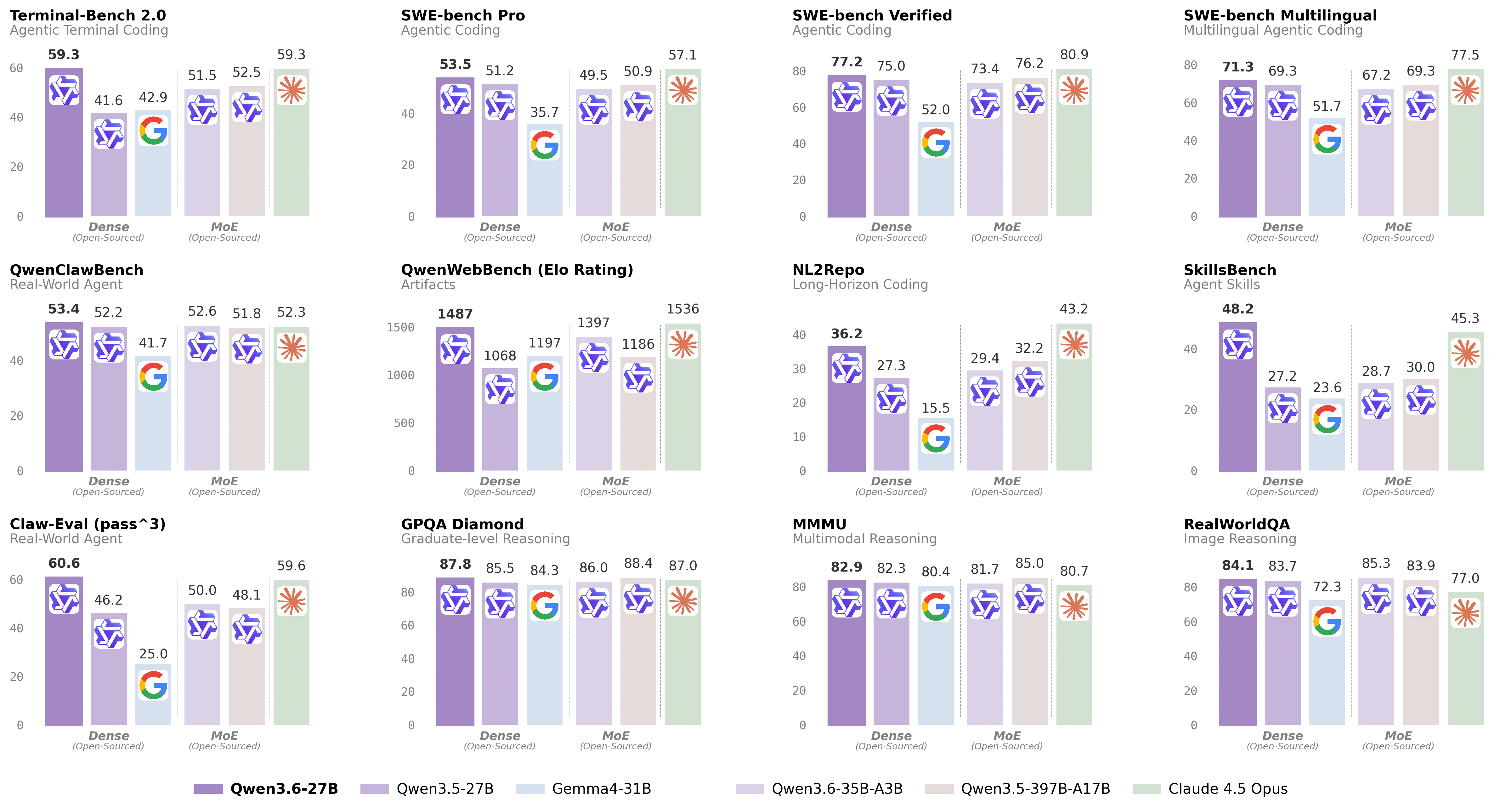
This is an extremely impressive result and I wanted to verify it by running the benchmark locally. If I can get 3.5x the speed to similarly accurate results, then I’m all for it!
Local Benchmarks
I set off to run the benchmark locally. I cloned the SWE-bench and mini-swe-agent repositories and got everything running… And I immediately realized that this was not as simple as I expected. Running these LLM benchmarks is not like running a benchmark against a typical algorithm. It’s slow! (particularly on commodity hardware.) To give you an idea of just how slow, the average time to completion I was seeing for a single task was about 15-25 minutes. The SWE-bench verified tasks (which is only a subset of the full SWE-bench set) contains 500 tasks. So at 15 minutes per task, the full ‘verified’ set would take over 5 days of my GPU cranking 24 hours a day. So I settled on the ‘Lite’ subset, which is designed to be simpler, allowing for faster completion.
Here, faster is relative. I didn’t want to wait 24 hours for a result so I took a subset of the subset, the first 50 tasks in SWE Bench Lite. I also limited the allowed time per task to only 5 minutes. I figured this would level the playing field between the MoE model and the dense model and also save time on the data collection.
# mini.yaml - configuration overrides allowing me to hit my local LLM
model:
  model_name: "openai/qwen3.6-2b"
  cost_tracking: "ignore_errors"
  model_kwargs:
    api_base: "http://192.168.1.173:8080/v1"
    api_key: "not-needed"
    drop_params: true

agent:
  wall_time_limit_seconds: 300 # 5 minutes
# Example of running through the tasks
mini-extra swebench \
  --config /path/to/default/swebench.yaml \
  --config mini.yaml \
  --output bench-27b \
  --subset lite \
  --split test \
  --slice ":10" \ # I ran the tests in increments of 10 tests so I could check the progress
  --workers 1
Results
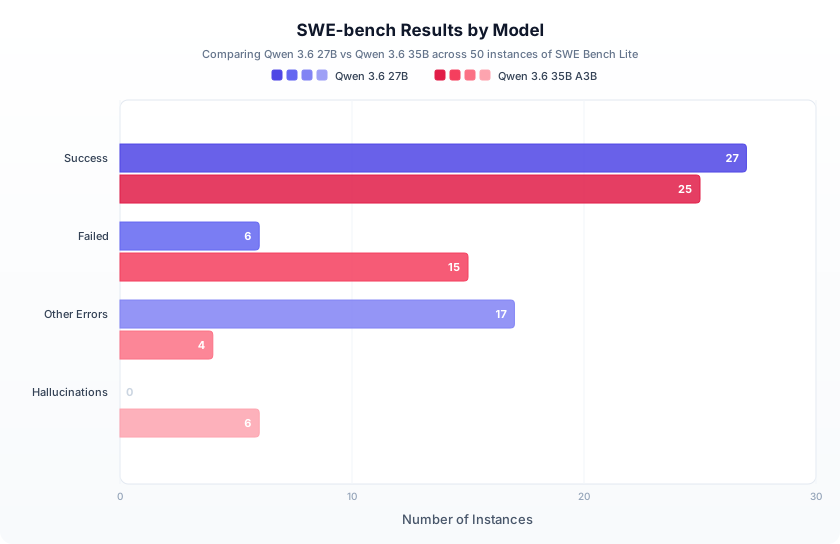
Here are the results of my local benchmark:
Note:
The other errors category comprisesTimeout,RepeatedFormatError,ContextWindowExceededErrorQwen 3.6 27B:
- 17 Timeouts
Qwen 3.6 35B-A3B
- 4 Timeouts
Some Thoughts
My absolute numbers are lower than Qwen’s published results, which isn’t surprising. The agent harness matters — I used the default mini-swe-agent while Qwen almost certainly used a more optimized one. Q4_K_M quantization also has a cost. And my aggressive 5-minute time limit hurt the dense model more, since it takes longer due to its token generation performance.
That said, the gap between the two models is what I’m most interested in, and here the results roughly hold: the dense 27B model completed only 2 more tasks than the MoE variant, which is consistent with Qwen’s claimed 5–10% difference.
But task completion rate alone isn’t the full story.
Confidently Wrong
What jumps out is not how many tasks the MoE model failed to complete — it’s how often it completed a task incorrectly and submitted anyway.
- 37.5% of submissions contained code that did not fix the issue (15 out of 40)
- 15% of submissions were invalid patches — the evaluator couldn’t even apply them; the model had hallucinated invalid content for the diff
- Combined: the MoE model was confidently wrong 52.5% of the time it produced an answer
Caveat:
Because the 27B model timed out more frequently under the 5-minute limit, I may not have given it enough rope to hallucinate at the same rate. For a fair apples-to-apples comparison, both models should be allowed to run to completion. This is why i’m not calling out the direct comparison between the accuracy rates of the two models here.
Update 2026-08-08
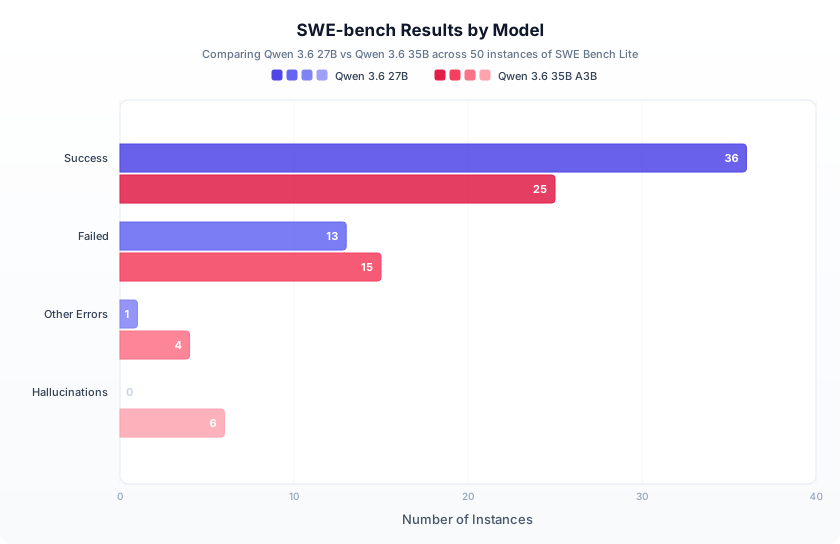
Because of the caveat above, I wanted to see if I could create a more fair comparison for the MoE variant. I gave both models 15 minutes per task on all tasks that had previously timed out and ended up with a different picture. I’ve included the results below and updated my Takeways to reflect the behavior shown.
Note:
The other errors category comprisesTimeout,RepeatedFormatError,ContextWindowExceededErrorQwen 3.6 27B:
- 1 Timeouts
Qwen 3.6 35B-A3B
- 3 ContextWindowExceededError
- 1 RepeatedFormatError
With my hardware, and variants of the two models 27B was significantly more accurate. I found a 33% improvement in task completion bringing over all completion rate to an impresive 72% which isn’t far off of the official results. Unfortunately I found that both models were quite happy to submit wrong answers. Given more time, the dense model went from 6 wrong answers to submitting 13.
Giving the dense model 3x the time to complete the task drove significant results. Giving the MoE task more time to complete the results did not improve its score at all.
Takeaways
None of this is meant to discourage you from using Qwen 3.6 — I use the dense 27B variant as my daily driver and it’s excellent. The point is more nuanced:
On model selection: The MoE variant is the right tool for high-volume, low-stakes tasks where you’ll review the output anyway — scaffolding, boilerplate, first drafts. For agentic tasks where the model submits code autonomously and you want it to be right, dense models may be more appropriate.
On benchmarks: Published numbers are a starting point, not a verdict. Quantization, agent harness, time limits, and task distribution all affect results significantly. Particularly, for local LLMs, run your own experiments on your own hardware before making architectural decisions, but bring your patience.
On confidence: This is the one that I hadn’t really considered when labs post their scores. A model that submits a plausible-looking but broken patch has failed invisibly. I found that the MoE variant did this frequently both the dense model and the MoE variant did this frequently when given enough time. That’s the real risk of leaning on these local models for autonomous work. Right now they are still just tools that require human oversight, albeit extremly powerful, almost magical tools.